

Picture the moment someone taps a glass for the thank-you. Half the team might be seated with a plate, still in the buffet line, or already pushing chairs back for the dance floor. Which one it is comes down to how the food is served, and that's one of the first questions in a caterer's reply. Plated, family-style, a buffet, chef stations, a grazing table and canapés on trays each fit a different kind of evening, and for a team of 20 to 100 the choice follows the night itself: when the thank-you happens, and what the room turns into after dinner.
By Friday, November 27, write to each caterer you're considering with the headcount and two things about the evening. One is the room: its size, and whether it has a kitchen and tables of its own. The other is the timeline, from the doors to the hour the venue wants the room back, with the speeches marked. If you've already written a run of the night (our two-week plan for a team of 20 to 60 ends with one), send that page instead.
A seated dinner, when the night has speeches
Plated service is the one to pick when the evening has a centre: a welcome, then a thank-you from whoever leads the team. Everyone has a seat, nobody is in a line when the first person stands up, and each course leaves the kitchen hot and at once.
Plated tends to cost more, because it needs more staff, and guests usually choose their meals in advance. It also suits guests with mobility issues, who don't have to carry a plate across a crowded room.
Savoury Chef's corporate holiday party page lists "a formal plated affair" among its options, for events "From black-tie corporate holiday galas to relaxed celebrations." The page gives no minimum or notice period, and those are the first two questions to send. On your side, plated asks for each guest's meal choice with their reply, and a seating plan.
Shared platters or a buffet line
If the team would rather pass dishes around than be served a plate each, the food can come to the table on shared platters, or wait on long tables for people to help themselves. White Table Catering's 2026 holiday menu offers both, "a seated family-style dinner, a beautifully composed buffet," and its corporate page says this year's menu is "built for corporate calendars."
Away from its Mount Pleasant dining room, Tayybeh caters Syrian dips, salads and hot dishes on sharing platters. "Sharing food is such an important part of Syrian hospitality," its founder, Nihal Elwan, told us, "and it makes a group dinner feel especially warm and festive."
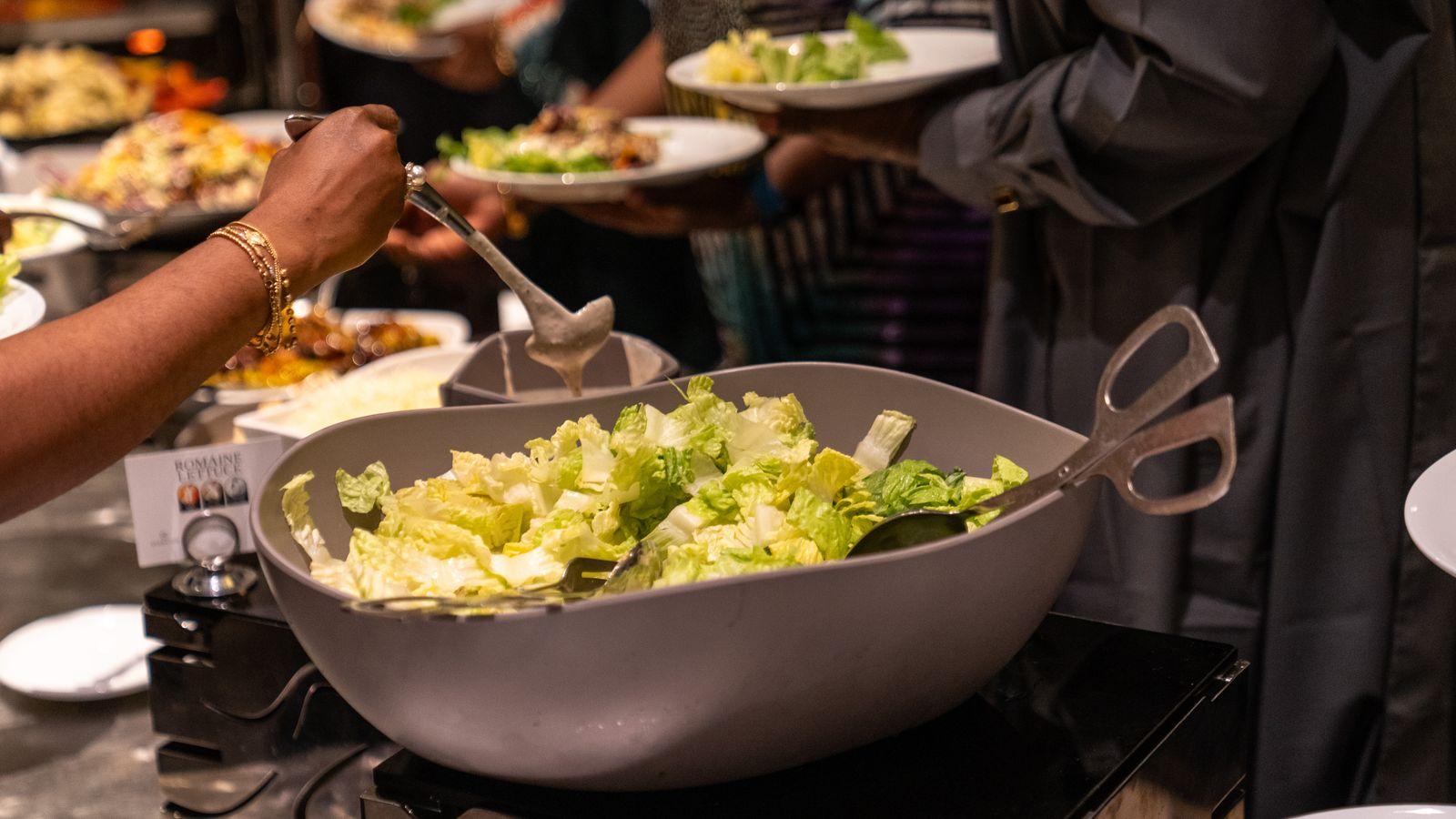
Family style keeps everyone seated for the speeches, and passing a dish down the table gets people talking who don't usually sit together. It needs larger tables for the platters and more staff to carry them, and caterers often set a minimum number of guests for it. White Table's pages don't name one. A buffet suits a larger, looser crowd if the room has space for the long tables and the line in front of them, and the speeches wait until everyone has sat down with a plate.
Chef stations, cooked in front of the room
Railtown Catering's event menu calls its chef stations "ideal for corporate receptions, late night snacks, and more," and that's the night they suit, with a chef carving at one table and guests drifting between stations with a drink. A station also gives two colleagues who've only ever traded emails a reason to talk while they wait in the same line, and a late one suits a party whose second half is for dancing.
Railtown prices station items per person, with a "minimum 30 portions per item," so a team of 25 orders 30 of each.
Paella La Flamenca makes the whole dinner a station. Its chefs cook the paella on site, in front of the guests, and serve it straight from the pan to groups of fifteen or more, and they ask the host for an electrical outlet and a 10-by-10-foot space, though they can adapt to a smaller room.
Sharing food is such an important part of Syrian hospitality, and it makes a group dinner feel especially warm and festive.
One long table to graze from
A grazing table feeds a standing party from a spread of cheese, cured meat, fruit and dips that people come back to all evening. Sweet & Salty Boards sizes its grazing tables by guest count, from half a metre for 25 to 35 people to two metres for 75 to 100. Its page for corporate events, which lists holiday parties among the office events it caters, says graze tables start at a minimum of 35 people.
Sweet & Salty asks you to provide "a table or kitchen island and a table cloth if preferred," and its team arrives two hours before the event to build the spread, so the room has to be open by then. For a smaller group, Capilano Cafe Market in North Vancouver sets a minimum of 20 people for its grazing table, with delivery and setup included in the Lower Mainland.
For food that sits out on a buffet, a grazing table or a station, HealthLink BC says to keep hot foods "at or above 60°C" and cold foods "at or below 4°C," and not to leave meat, poultry, fish or dairy at room temperature for more than two hours. It's a fair question for whoever builds the spread: how long is it meant to stay out, and what's kept cold to refill it?
Canapés on trays, for the first hour or the whole night
Canapés on trays keep a standing room fed without a queue, and they pair easily with another style, an hour of them as people arrive and then dinner. A cocktail-style reception often costs less, too, because there's no full meal. If they're all the food, tell the team it's a reception, so nobody arrives hungry.
Railtown's canapés "require chefs onsite for assembly, and in some cases oven and other kitchen equipment," with a minimum of three dozen per item. Before you settle on them, find out whether the venue's kitchen has an oven the chefs can use.
Dietary needs, style by style
The dietary list arrives with the replies, and Health Canada's priority allergens make a good checklist: eggs, milk, mustard, peanuts, crustaceans and molluscs, fish, sesame seeds, soy, sulphites, tree nuts, and wheat and triticale. Send the caterer the real list, with names.
Plated is the simplest case, because the kitchen can make one plate for one guest. At a station, a guest can ask the chef what's in the dish. Shared platters, a buffet and a grazing table put foods side by side, so ask how a guest with a serious allergy gets a meal of their own.
Then ask what the kitchen can promise. Railtown Catering's corporate menu page answers in one line: "Railtown Catering is not an allergen free facility, however we will do our best to avoid cross-contamination." An answer that clear lets you tell a guest what to expect before they arrive.
Photos by Justin Agyarko, Matheus Bertelli, Kinz-studio Photographe and Mohammed-Ali Hamadache on Pexels.
Join the conversation
Loading comments…