

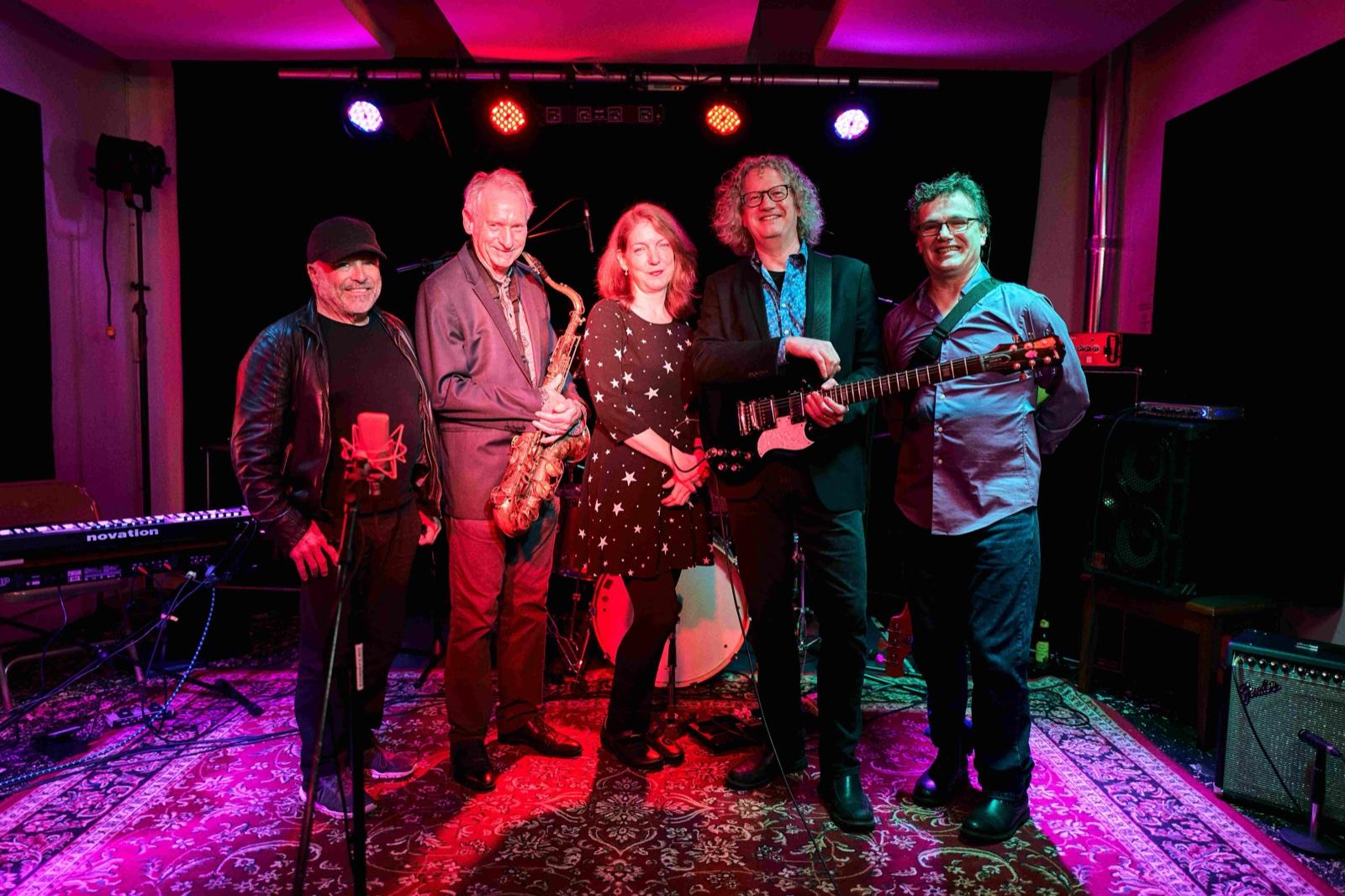
It's nine o'clock at an office holiday party somewhere in Vancouver. Dinner is done, the speeches are over, and the sound coming from the corner of the room changes: the saxophone leans in, the organ fills the space, and a few people who were heading for their coats put them down.
If a friend asked us for a band that could do that, we'd send them to SoulDriver. What drew us to them is how they talk about a room: how loud it should be, when to play and when not to, and what the host needs to think about before the band even arrives.
SoulDriver is five musicians: Mark Geraghty on bass, Gord Robertson on guitar, Jennifer Orme on drums, Bob Walker on saxophones and Jay MacDonald on keyboards. No singer. Their own description is "that 60's soul feel with a modern blues/jazz twist": classic soul, blues and jazz tunes from the sixties and seventies, and newer songs played in that style. In Vancouver you'll find them most often at 2nd Floor Gastown, where they played the TD Vancouver International Jazz Festival's club series two years running, at the Painted Ship in Kitsilano, and at Mount Pleasant Days.
I didn't know I liked jazz
Ask Jennifer what they play and she'll tell you about the people who come up between songs. "We have had audience members ask what type of music it is that we are playing," she says, "because sometimes they are unsure if they usually listen to a rock/contemporary pop background." The answer, once they hear it, tends to be the same: "Wow! You guys sound great! I didn't know I liked jazz, but this is amazing!"
The style has a name, soul jazz, and Jennifer describes it as deep-grooving and danceable: a rhythm section that keeps the music in the pocket, blues and gospel in the melodies, warm organ textures from the keys, and a saxophone that's gritty and vocal rather than academic. It stretches further than the name suggests, into "60s soul and r&b, gospel, and even a country tune." Their set list runs from "Let's Stay Together" and "Living for the City" to "Mercy, Mercy, Mercy," "Cantaloupe Island" and "Moanin'."
Quiet for dinner, creative flow later
The first thing Jennifer says about a party is that the music is built around it, not the other way round. "Usually a client will give us the time length that we have, and we will work out how many sets (how long to play consistently) to work out in that time frame," she explains. Sets run forty-five minutes to an hour. If there are speeches or announcements, the band works them into the plan and sits out when it should, and the client gets a written itinerary before the night.
The most common ask is a block of three to four hours, six to midnight, three sets. The shape of the night tends to repeat too: "We will often get a request to play a quiet set during a dinner and then a more lively, let-all-the-stops-out set later on in the evening." Any time works for live music, in her view; she's had requests for every hour of the day.
What surprises hosts most is how quiet a five-piece with drums can be. In a small room, or for a dinner set at a place like 2nd Floor Gastown, Jennifer puts down the sticks.
Clients can sometimes be reluctant with the idea of drums and are very pleased when they see how conversation-level quiet they can really be.
Brushes instead of sticks, she says, give "a very quiet gentle sound, just outlining the rhythm." The band is always the full five; what changes is the volume, and that's a conversation they have with every client while planning the music part of the event.
A twelve-foot square and two outlets
Hosts are often unsure what a band needs, so SoulDriver takes care of it and tells them what's covered. The band brings all of its own equipment, down to a battery for places with no power at all, like an outdoor community event. What they ask for is modest: a twelve-foot square to play in ("we can fit a five piece into a surprisingly small footprint"), access to two power outlets, and an hour before the start to set up, which they usually do in under an hour.
They play at stage volume, meaning the sound comes from the amps and the acoustic drums, with no big speaker system unless the room is large, the crowd is large and the client prefers it. Jennifer's reason is control: it gives them the best handle on their sound, especially for smaller or quieter events.
On a live band versus a playlist, her case is that a band can read the room. If the dinner portion is running long, as she puts it, they can stretch out a smooth, ambient blues texture, then pick up the tempo when it's time for cocktails and dancing. No two nights are the same, and for a December party they can fold holiday songs into the set. Her one practical note: they can't predict how busy December will be, so reach out ahead.
Back at that party, it's the third set. The brushes went back in the bag an hour ago, the saxophonist is elevating an inspired improvised solo, and the people who put down their coats are the ones nearest the band, asking between songs what this music is called.
Photos: Julian Fok, courtesy of SoulDriver.
The Spotlight is where the Journal writes about the Vancouver Event Pros we'd send a friend to, like Jennifer, Mark, Gord, Bob and Jay.
Join the conversation
Loading comments…